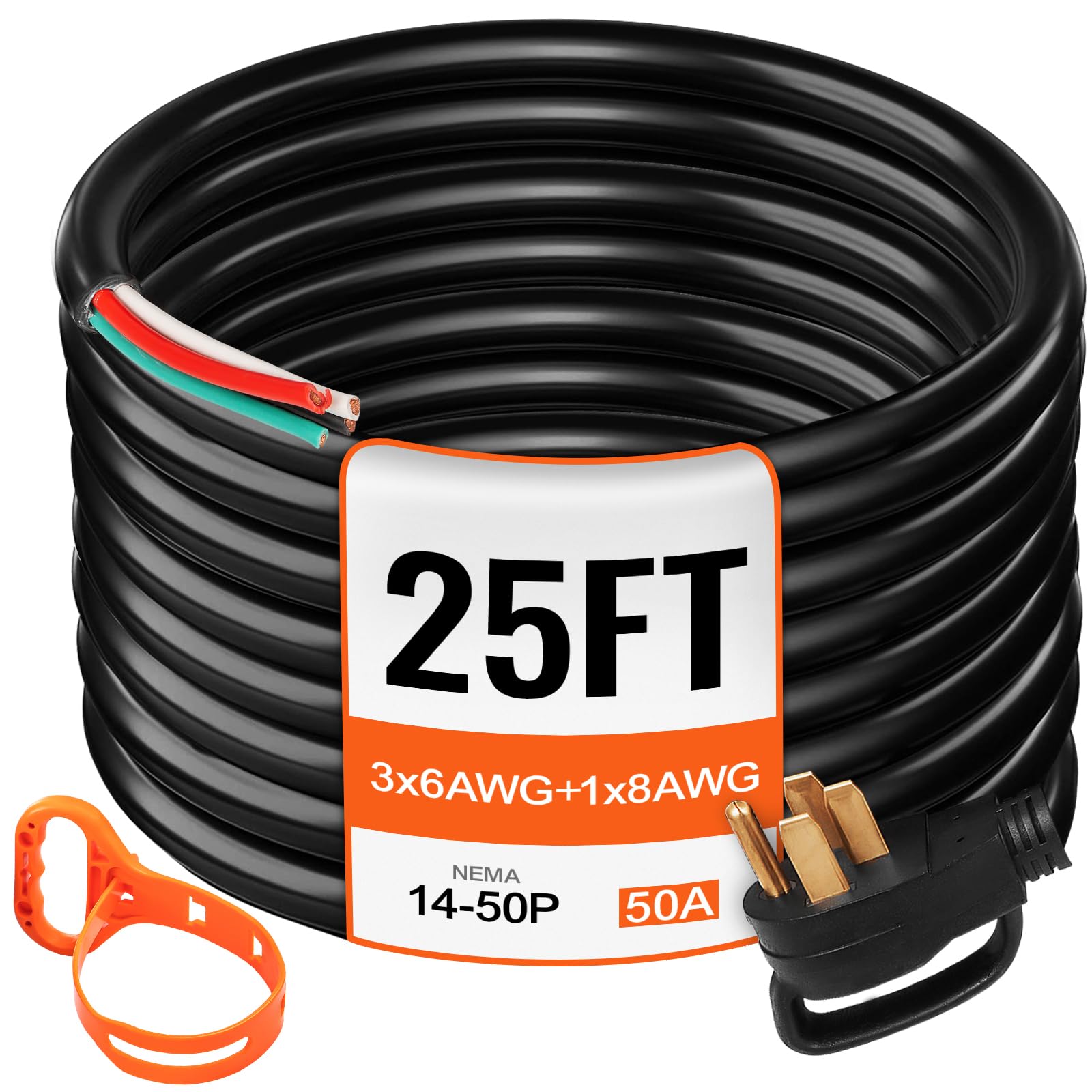
This VEVOR 50 Amp Generator Extension Cord review looks at a 25-foot cord built for generator connections where one end needs a NEMA 14-50 plug and the other needs to be terminated for a transfer switch or power inlet.
VEVOR Generator Cord Review Summary
The quick verdict
600+ ratings
Read Amazon ReviewsVEVOR 25-Foot 50 Amp Generator Extension Cord
A practical fit for RV owners and homeowners who need a 25-foot generator lead with a NEMA 14-50 plug and a bare-wire end for custom connection.
- 25-foot extension cord with a NEMA 14-50P plug on one end and a bare-wire cut end on the other.
- Four conductors in a 6/3+8/1 AWG configuration, described as pure copper.
- Rated for 50 amps and specified for 125/250 volts, with a maximum listed power capacity of 12,500 watts.
- STW thermoplastic jacket described as resistant to moisture, sunlight, oil, and abrasion.

Pros
- Bare-wire end allows the cord to be terminated for a compatible transfer switch or power inlet.
- The 25-foot reach can help position a generator farther from the RV or home connection point.
Consider before buying
- The bare-wire end is not a ready-made plug connection; buyers need a compatible installation plan and appropriate termination.
- Its 50-amp rating and NEMA 14-50P plug limit it to equipment and connections designed for those specifications.
Read the full review summary
The cord pairs a four-conductor, 6/3+8/1 AWG copper design with a 50-amp rating and a maximum listed capacity of 12,500 watts at 125/250 volts.
Its 25-foot length offers some placement flexibility, while the bare-wire end allows a qualified installer to make a custom connection for a compatible setup.
It is most relevant to RV owners or homeowners planning a generator connection that specifically calls for this plug-and-wire configuration.
The all-weather STW jacket, grip handle, and ETL certification add useful design details, but buyers should verify the transfer switch or inlet requirements and have the bare-wire termination completed appropriately.
The buying factors
VEVOR Generator Cord Scorecard
Editorial scores reflect listed features and buyer fit; they are not laboratory measurements or customer ratings.
Connection flexibility
The NEMA 14-50P plug and bare-wire end suit installations that need a plug on one side and a custom termination on the other.
Reach
A 25-foot length gives more placement flexibility than a short lead, subject to the site's layout and cord routing.
Electrical capacity
The product is specified for 50 amps and up to 12,500 watts at 125/250 volts, making compatibility checks essential.
Outdoor jacket design
The STW thermoplastic jacket is described as resisting moisture, sunlight, oil, and abrasion, with a stated operating range from -40°F to 140°F.
Installation readiness
The bare-wire end supports custom installation, but it requires the correct matching equipment and a suitable termination.
Documentation signals
ETL certification and a one-year warranty are useful product details for buyers comparing generator cords.
Key Features and Specifications of VEVOR Generator Cord
- 25-foot extension cord with a NEMA 14-50P plug on one end and a bare-wire cut end on the other.
- Four conductors in a 6/3+8/1 AWG configuration, described as pure copper.
- Rated for 50 amps and specified for 125/250 volts, with a maximum listed power capacity of 12,500 watts.
- STW thermoplastic jacket described as resistant to moisture, sunlight, oil, and abrasion.
- Specified flexibility in temperatures from -40°F to 140°F.
- Ergonomic grip handle on the plug; ETL certified and covered by a one-year warranty.
Pros and Cons of VEVOR Generator Cord
Pros
- Bare-wire end allows the cord to be terminated for a compatible transfer switch or power inlet.
- The 25-foot reach can help position a generator farther from the RV or home connection point.
- The stated 50-amp, 125/250-volt capacity suits setups designed for this cord configuration.
- Outdoor-oriented jacket properties and ETL certification provide helpful selection details.
Consider before buying
- The bare-wire end is not a ready-made plug connection; buyers need a compatible installation plan and appropriate termination.
- Its 50-amp rating and NEMA 14-50P plug limit it to equipment and connections designed for those specifications.
- At 25 feet and 18.3 pounds, it may be less convenient to handle and store than a shorter or lighter cord.
Who Should Buy VEVOR Generator Cord?
Good fit
Consider this VEVOR cord if your generator connection requires a 50-amp NEMA 14-50P plug at one end and a bare-wire termination at the other.
That arrangement can be useful when connecting to a compatible transfer switch or inlet, and the 25-foot length gives room to plan generator placement around the connection point.
Before buying, compare the plug, conductor arrangement, voltage, amperage, and termination needs with your generator and receiving equipment.
The cord's stated maximum is 12,500 watts at 125/250 volts; confirm that the rest of the setup is designed for those specifications and arrange suitable installation for the cut end.
Who should skip it
Skip this configuration if you need a finished plug at both ends or your equipment uses a different connector, length, voltage, or amperage.
Look elsewhere if you need a lighter, shorter lead for frequent handling; this cord is 25 feet long and weighs 18.3 pounds.
What the VEVOR Generator Cord's design means for your setup
The bare-wire end shapes the installation
This cord is intended for a connection that can accept a custom-terminated end.
That offers flexibility when the receiving point is a compatible transfer switch or power inlet, but it also makes connector matching and proper installation central to the purchase decision. Check what termination your equipment requires before choosing it.
Length adds placement options
At 25 feet, the cord can reach farther than a short connection lead and may let you position a generator with more room to work around the connection point.
The right length depends on the actual route, including where the cord must pass and how much slack is useful; avoid assuming that extra length will suit every installation.
Capacity needs to match the full system
The 50-amp rating and 125/250-volt specification describe a cord intended for a particular class of generator connection.
Its stated maximum power is 12,500 watts, so compare those limits and the 6/3+8/1 AWG conductor configuration with the generator and receiving equipment before use.
Outdoor jacket details support planning
The STW thermoplastic jacket is described as resisting moisture, sunlight, oil, and abrasion, and as flexible across a specified temperature range.
Those are useful considerations for outdoor routing and storage, though they do not replace checking the route, conditions, and handling needs at your site.
Alternatives to VEVOR Generator Cord
No alternative model is recommended here. Compare the connector, length, and capacity your setup requires before choosing another cord.
Is VEVOR Generator Cord Worth It?
The VEVOR 25-Foot 50 Amp Generator Extension Cord is worth considering when your setup calls for a NEMA 14-50P plug, a bare-wire termination, and a 25-foot reach.
Its listed capacity, outdoor-oriented jacket, and ETL certification make it a clearly specified option for that use.
Buy only after confirming that the cord's connector, electrical ratings, and conductor arrangement match your generator and receiving equipment. If you need a ready-to-use cord with plugs on both ends, a different configuration will be a better fit.
Your review at a glance
600+ ratings
Read Amazon ReviewsVEVOR 25-Foot 50 Amp Generator Extension Cord
A practical fit for RV owners and homeowners who need a 25-foot generator lead with a NEMA 14-50 plug and a bare-wire end for custom connection.
- 25-foot extension cord with a NEMA 14-50P plug on one end and a bare-wire cut end on the other.
- Four conductors in a 6/3+8/1 AWG configuration, described as pure copper.
- Rated for 50 amps and specified for 125/250 volts, with a maximum listed power capacity of 12,500 watts.
- STW thermoplastic jacket described as resistant to moisture, sunlight, oil, and abrasion.